CD-MAN
A DOS maze game from 1989 · kept alive

CD-Man CD-MAN

Made in Sweden by Attila Biro and Anders Moree. Clear the dots, dodge the spiders and sharks, grab the key. Pick a version and play. No install, nothing to download.

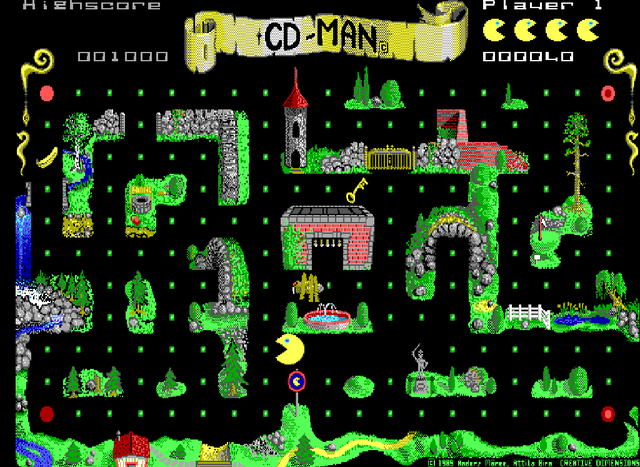
ORIGINAL CD-Man 1989: the Enchanted Forest maze in 16 EGA colours

Version 1 1989

The real thing: the 1989 game as Creative Dimensions released it for free copying, all 15 files unmodified. 16 EGA colours, PC speaker, the Enchanted Forest and the South Pacific. Runs in a DOS emulator in your browser.

Play version 1
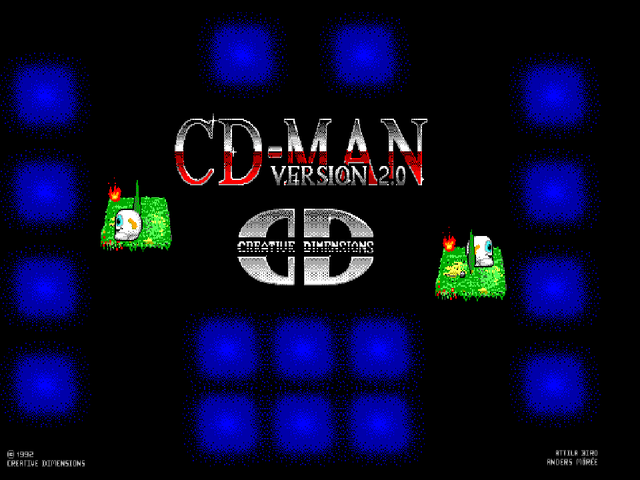
256 COLOURS CD-Man Version 2.0 (1992) title screen

Version 2 1992

CD-Man Version 2.0, by the same two creators: 256 VGA colours, five worlds, two-player and double mode. Plays in your browser at the Internet Archive.

Play version 2
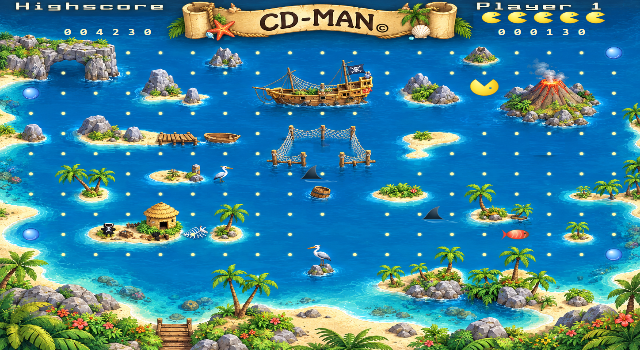
NEW · 2026 CD-Man Version 3: the South Pacific in the new HD artwork

Version 3 2026

A new browser remake of version 1, rebuilt with AI from the original program: same mazes, same rules, same sounds, with new HD artwork and a switch back to the 1989 graphics. Work in progress.

Play version 3
First things first

Thank you, Attila and Anders

Attila BiroCo-creator of CD-Man 1989 and Version 2.0 · Järfälla, Sweden
Anders MoreeCo-creator of CD-Man 1989 and Version 2.0 · Lidingö, Sweden · in Swedish, Mörée

CD-Man was made by two people at a small studio called Creative Dimensions, started in Stockholm in 1987. In 1989 they shipped a maze game with hand-drawn forests and islands, sharks with fins that swayed, a gate you had to unlock with a key, and a PC speaker that somehow sounded cheerful. Three years later they made it again, bigger, in 256 colours. The first one was shareware: you could copy it to a floppy and give it to a friend, as long as you passed it on unchanged.

That floppy reached a kid in Belgium. This site exists because that kid never forgot the game.

The welcome screen of the 1993 release asks for a voluntary contribution and promises: “The starving programmers at Creative Dimensions will be forever grateful to you!” For $10,000 they would erect a statue of you in their office. Consider this page the statue, thirty-odd years late, pointed the other way.

Attila, Anders: thank you. Your game is one of the reasons I love computers. Everything here is a tribute to your work. The original files are served exactly as you released them, your names are on every page, and nothing here is sold.

If you are Attila or Anders, or you know them, I would love to hear from you. And if you would rather have anything on this site changed or removed, just say so and it will be done.

Pieter

The story

An old DOS computer, two favourite games

We had one of those beige DOS computers at home, the kind that booted to a blinking cursor. Two games ruled it: Civilization, and CD-Man. Civilization was for long evenings. CD-Man was for right now: you typed cd-man, the yellow banner unrolled, and you were in the forest.

Decades later I still knew the maze by heart. The tunnel on the left. The key that appears somewhere and vanishes again. The moment the spiders turn grey and you chase them for once. I wanted to play it again, on any device, without hunting for an emulator. Then I wanted to understand how it worked. Then I wanted to build on it.

So this site has all three: the original as it was, the 1992 sequel, and a new version that starts from the original program and grows from there.

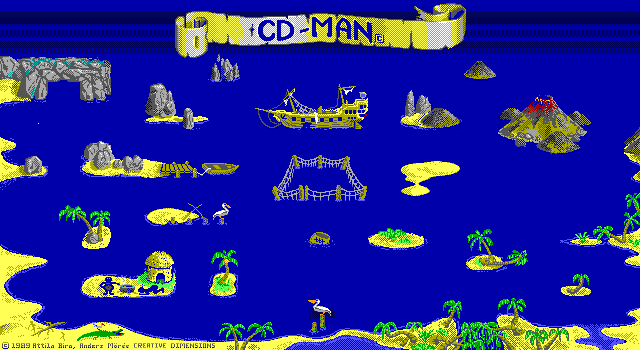
The South Pacific world of CD-Man 1989: blue sea, islands, a pirate ship and a volcano
The South Pacific, 1989. 640×350 pixels, 16 colours, and a volcano that erupts on a timer.
Three versions

1989, 1992, 2026

Version 1 · 1989

  • “Pre-release June 89”, Creative Dimensions, Sweden.
  • EGA, 640×350, 16 colours, PC speaker sound.
  • The Enchanted Forest and the South Pacific are complete. Deep Space was “in progress”; Cities of the World and The Dark Ages were only “initiated”.
  • Three rounds per world, a key and gate in the forest, a net that releases the sharks in the Pacific.
  • A hidden F1 key gives endless lives, left in “for testing purposes”.
  • Re-released unchanged in 1993 with a launcher and order form, when the bootleg copies had spread further than the official one.

Version 2.0 · 1992

  • “Designed and produced by Creative Dimensions, Anders Moree and Attila Biro.” The same two people, three years on.
  • VGA, 256 colours, five worlds instead of two and a half. One-player, two-player and a “Double” mode where both play at once, keyboard or joystick.
  • “An amazing new class of 256 color graphics with flicker free, seamless motion made possible by the new synchronized video engine we have developed.” (their own words, 1993)
  • A commercial product, sold by mail order from Pleasanton, California for $29 plus shipping, and in shops in Germany and Scandinavia.
  • Because it was sold and never released for free, this site does not host it. The Internet Archive does, playable in the browser.

Version 3 · 2026 WORK IN PROGRESS

  • A new JavaScript engine that runs in any browser, phone included. No DOSBox, no emulator.
  • Mazes, palettes, sprites, enemy behaviour, timers and sound tables recovered from the 1989 program itself.
  • New HD artwork painted over the exact original layout, with a one-click switch back to the 1989 graphics.
  • Speed slider, fullscreen, touch controls, and the original F1 endless lives.
  • Two worlds so far. New worlds are the plan.
Version 3

Rebuilding CD-Man with AI

No source code survived, only a 34 KB executable and its graphics files. Version 3 was rebuilt from those in a few intense days in September 2026, with Claude (Anthropic) writing the code and ChatGPT 6 Astra painting the artwork. Here is how.

Start from the real filesThe 1989 shareware zip, the 1993 re-release and the help file. The two releases were compared byte for byte: same game, same sounds.
Decode the graphicsThe .CDM files are run-length encoded EGA bitplanes. The AI wrote a decoder, pulled out the original palettes, both maze backgrounds and every sprite sheet.
Disassemble the programThe executable was disassembled and read routine by routine: the maze grids, where the tunnels connect, how the key appears and vanishes, how the gate animates.
Recover the behaviourThe enemy chase routine, release countdowns, the vulnerability timers, the bonus fruit table and the exact PC speaker notes (frequency = 1193182 ÷ divisor) were transcribed into the new engine.
Write a new enginePlain JavaScript, no dependencies, no build step. The game logic is separate from the drawing, so artwork can change without touching the rules. Over seventy automated tests check it against the recovered data.
Paint it in HDNew backgrounds were generated with AI image tools from the original screens, then fitted over the original grid pixel for pixel, so every dot, wall and tunnel is exactly where it was in 1989.

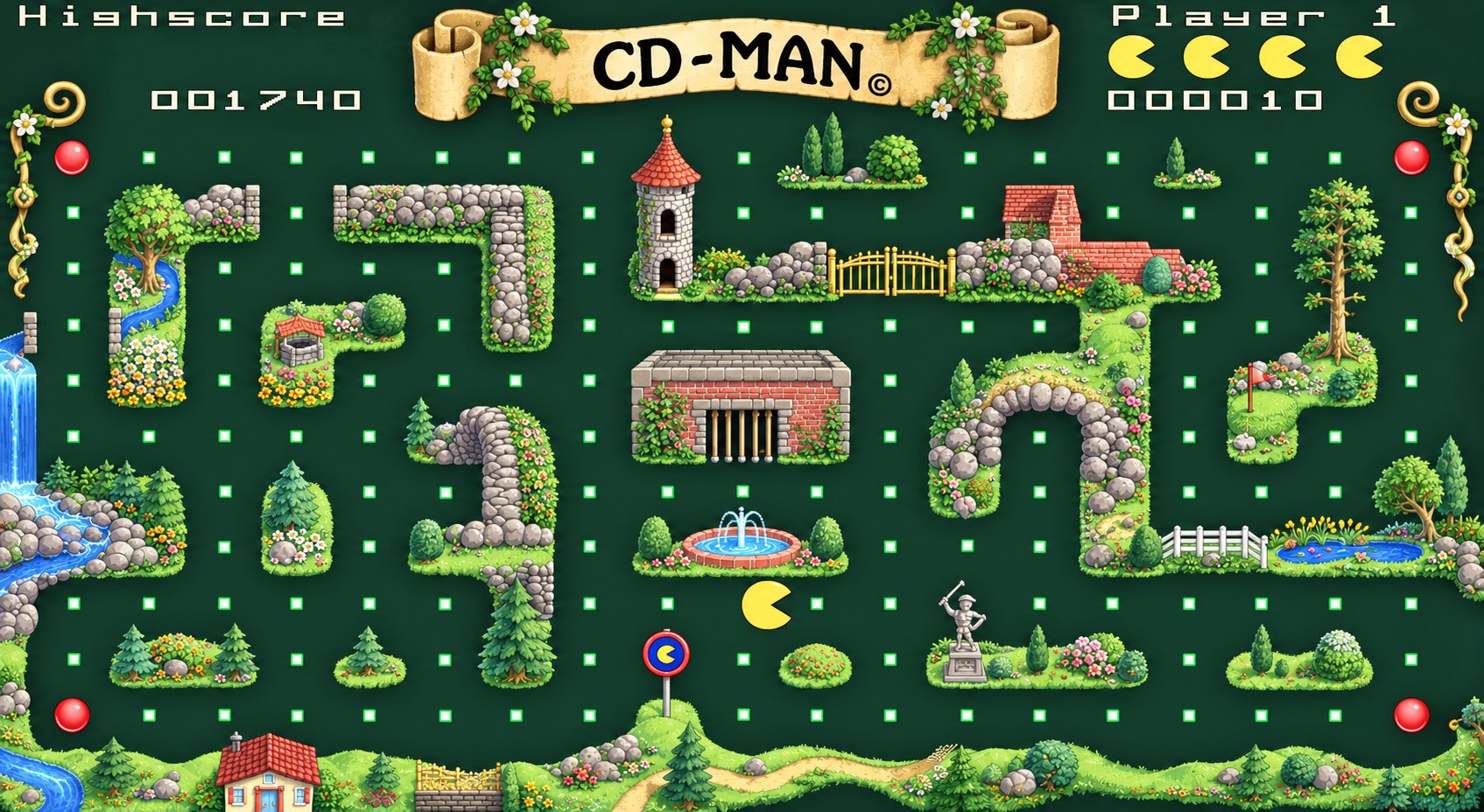
Version 3: the Enchanted Forest in the new HD artwork
The Enchanted Forest in version 3. Same maze, same dots, new paint.

Honest status

  • Forest and Pacific, three rounds each, playable start to finish.
  • Enemy behaviour, timers, key, gate, tunnels and sounds follow the original routines.
  • HD and original graphics, switchable mid-game.
  • The game speed is calibrated by feel, not recovered from the original timing loop.
  • The widened HD backgrounds still show seams between original and generated parts.
  • Deep Space, the unfinished third world, is not included.
  • Collision boxes are a modern approximation, not the original geometry.

The full engineering notes, with every recovered address and every deliberate deviation, are in the remake's sources file and readme.

What's next

Better, but not harder. And more worlds.

The goal is not a harder game. It is a game that feels as good as the memory: enemies that are a little smarter and more surprising, but still fair. Same rules, same rhythm.

And more levels. The 1989 help file lists worlds that were never finished: Deep Space, Cities of the World, The Dark Ages. Version 3 can go there, and beyond.

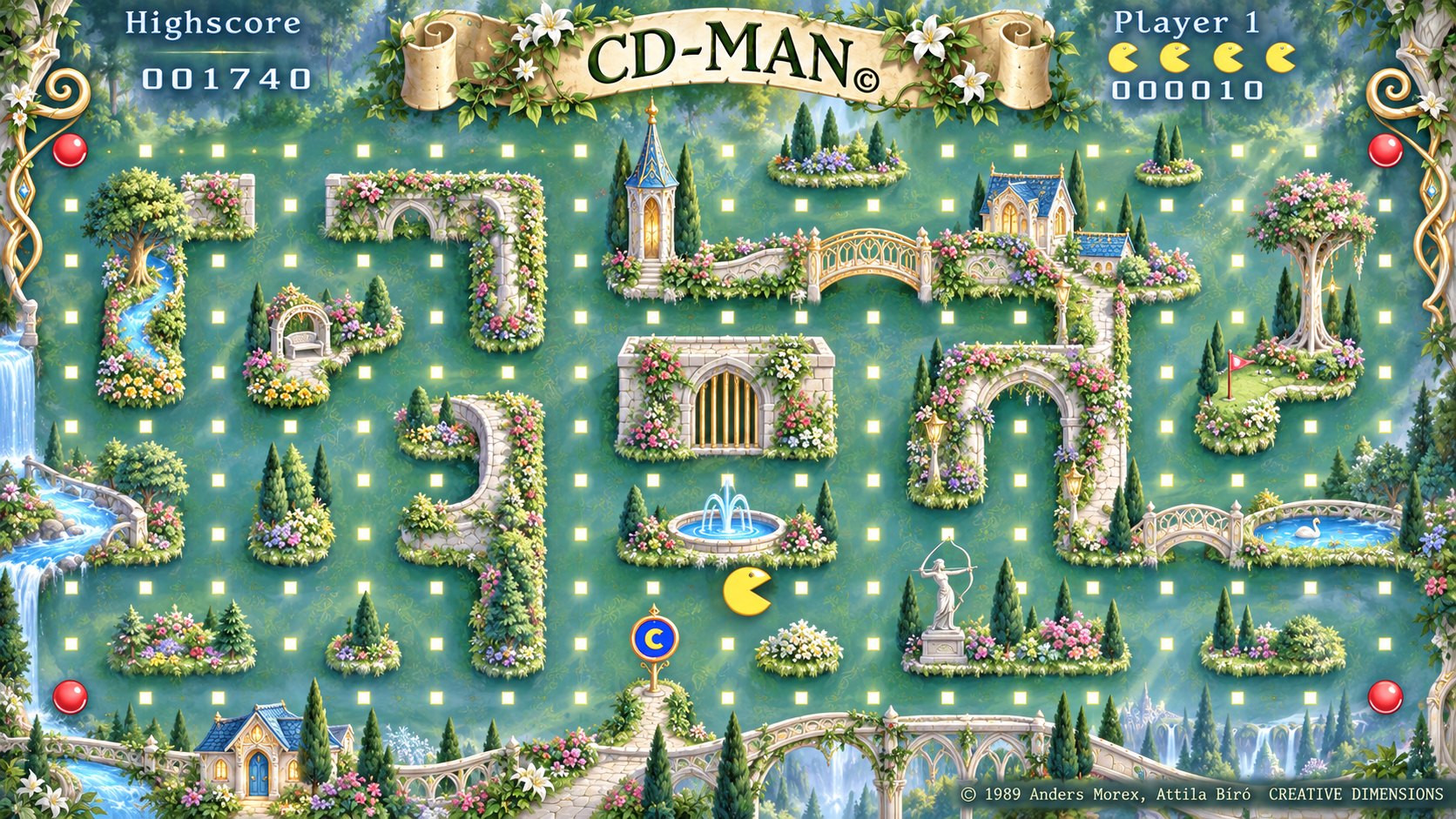
The first concept is an elven forest, somewhere between Rivendell and the original Enchanted Forest: white stone bridges, a fountain, a swan on a lake, an archer statue guarding the cage. It was sketched with an AI image model in one afternoon, using the original screen as the layout. It is a picture, not a level yet. The level comes next.

The painted backdrops behind the sections of this page are first sketches of those worlds, generated with ChatGPT 6 Astra. If there is a world you always wished CD-Man had, this is the place to say it.

Concept art for a new CD-Man world: an elven forest with white stone bridges, a fountain and a swan lake, laid out on the original forest maze
Concept for a new world, September 2026. Click for the full-size image.
Credits, sources, fair use

Who made what

CD-Man (1989) © Creative Dimensions, Attila Biro and Anders Moree.Programmed and drawn in Järfälla and Lidingö, Sweden. Creative Dimensions opened in Stockholm in 1987 and later moved to Pleasanton, California.

CD-Man Version 2.0 (1992) © Creative Dimensions, designed and produced by Anders Moree and Attila Biro.Commercial, all rights reserved. Not hosted here; linked to the Internet Archive.

Version 3 (2026) by Pieter Mekerlé, built with Claude (Anthropic) writing the code and ChatGPT 6 Astra (OpenAI) painting the HD artwork, the concept art and the backgrounds of this site.The original artwork and sounds remain the property of their creators.

Emulation by js-dos, which runs DOSBox in the browser.

About the original files. Version 1 was shareware. The README of its official 1993 release says it “may be freely distributed to your friends and to BBS's as long as all files specified below are included and that there are no modifications to them”. That is exactly how it is served here: that release, complete and unmodified, inside a DOS emulator. Version 2.0 was commercial and is not hosted. Nothing on this site is sold, and there are no ads.

Not affiliated. This is a personal fan site. It is not connected to Creative Dimensions or its founders. If you hold rights to CD-Man and want anything changed or removed, ask and it will be done.

Sources. DOS Games Archive (1989 release) · DOS Games Archive (1993 re-release) · DOSGames.com · the original CD-MAN.HLP, README.CDM, CD.TXT and FOREIGN.TXT files.